Cuba inside a Piano

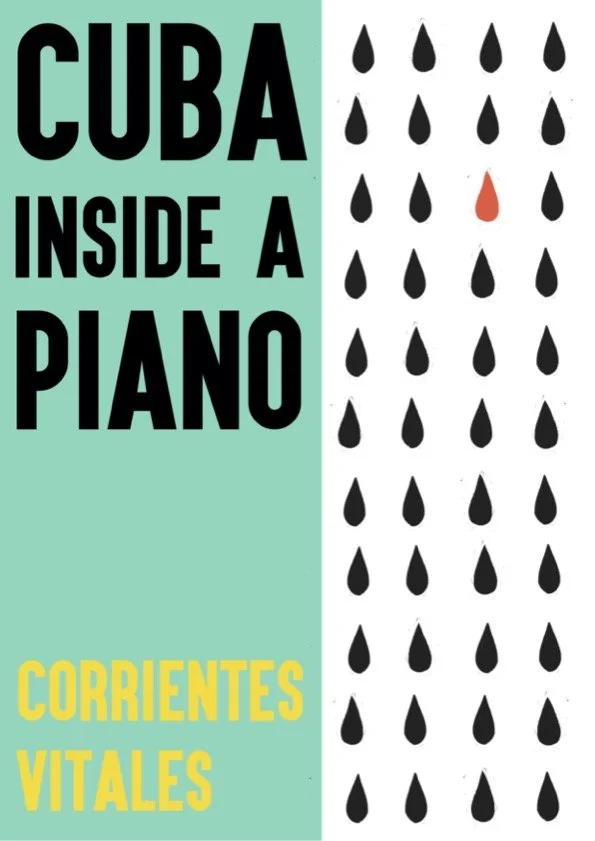
Designed by Luna Carlos Armengod
Berlin, winter. The city is quiet in a way that makes distance feel sharper. It was there, among streets of stone and silence, that Cuba Inside a Piano quietly began to take shape. Not as a project, exactly, but as a need — a way to give form to memories and impulses that had no other outlet. The piano, present since childhood, had been a companion rather than a stage. It had been part of home, among toys, gradually becoming a space where thoughts, feelings, and fragments of memory could take sound.
The first image that came to me — unremarkable yet persistent — was a piano containing an island. Not literally, but emotionally: a vessel in which the history, the rhythms, and the contradictions of Cuba could coexist, even at a distance. The phrase “Cuba Inside a Piano” is less a title than a mental map: a place where nostalgia, memory, and music converge and travel.
In Europe, tension was constant. There was the subtle pressure of classical expectations, the weight of a canon that often questioned interpretation. There was also the challenge of bringing Cuban popular music into spaces meant for concert tradition. That friction became part of the work itself. The piano — black and white keys — a quiet metaphor for dialogue, negotiation, coexistence. Here, tradition meets experimentation; the familiar meets the unfamiliar; what is ancestral finds a voice alongside what is contemporary.
The program itself moves fluidly between Spanish song forms, contemporary arrangements, and the pulse of Afro-Cuban rhythms. Echoes of early twentieth-century Cuban composers surface, not as homage, but as threads woven into a present, living sound. Influence is not only musical: the sound of Havana’s streets, literary rhythms, Afro-Cuban spiritual practices, the quiet of European rooms — all feed the work. Sometimes the distance feels like a filter, clarifying what is essential, showing what survives beyond geography and expectation.
The pandemic added an unexpected dimension. Performances became introspective, intimate conversations conducted across distance. Nostalgia shifted from longing to listening — listening to memory, to silence, to what persists when time and space separate the island from its diaspora. The music became a vessel not for display, but for reflection, for navigation.
If the project could be condensed into a single idea, it might be this: the piano as a territory where the memory of an island transforms into contemporary language, where past and present converse without trying to reconcile entirely. And yet, the project is not about claiming or defining Cuba; it is about opening a space where the island can breathe, move, and speak through sound, where listeners may encounter it as they will.
In the end, Cuba Inside a Piano is about listening — to memory, to rhythm, to silence, and to what happens when a piano becomes a small, portable island of its own.
TRAILER
Original Crew
Featuring musicians Arturo Martinez, Judith de Haas, The Classic Vibrations String Quartet, Wiljop Mounkassa Williams, and Vito Giacovelli.
Stage design and performance by Luna Carlos Armengod.
Produced by Leonardo Reyna
Film direction Roberto Mahnaes
Additional production Fiete Wullf (Insola Berlin) and Alban Steingraeber